
The chest is one of the most defining features of a masculine physique. For many men in New York City, it’s also one of the most frustrating — not because they haven’t put in the work, but because the issue isn’t one that can be solved in the gym. Whether the concern is excess glandular tissue that creates unwanted fullness, or pectoral muscles that simply won’t respond to training the way they should, the root cause matters enormously.
Two of the most effective procedures for male chest contouring, pectoral implants and gynecomastia surgery, address fundamentally different problems. Choosing between them, or understanding whether both apply, starts with an honest assessment of what’s actually driving your chest concerns.
What You Should Know Before Choosing a Chest Procedure
- Gynecomastia is caused by excess glandular tissue or fat — not a lack of muscle development.
- Pectoral implants add size and definition to underdeveloped chest muscles, not remove tissue.
- The right procedure depends entirely on the underlying anatomy, not appearance alone.
- In some cases, both procedures can be performed together for a more complete result.
- A consultation with a board-certified plastic surgeon is the only reliable way to determine which approach fits your goals.
Two Procedures, Two Very Different Problems
Men often arrive at the conversation about chest contouring assuming the issue is singular — that a flat or disproportionate chest simply needs augmentation, or that unwanted fullness just needs to be reduced. In reality, the anatomy at play is quite specific, and confusing the two can lead to pursuing a procedure that doesn’t address what’s actually there.
Gynecomastia involves the presence of excess breast tissue — either glandular, fatty, or a combination of both — that causes the male chest to take on a rounded, feminized appearance. It is not a reflection of body fat percentage or fitness level. Many men with gynecomastia are lean and physically active; the tissue simply doesn’t respond to exercise or weight loss because it isn’t fat-based.
Pectoral implants, by contrast, are designed for men whose chest muscles are structurally underdeveloped — either due to genetics, a prior injury, a condition like Poland syndrome, or pectoral muscles that have plateaued despite consistent training. These men typically have a flat or asymmetrical chest that lacks the volume and definition they’re looking for, not excess tissue.
Understanding this distinction is what makes chest contouring effective rather than merely cosmetic.
Gynecomastia Reduction: Removing What Doesn’t Belong
Gynecomastia reduction is a surgical procedure designed to eliminate excess breast tissue from the male chest area and restore a flatter, firmer contour. Depending on the composition of the tissue — glandular, fatty, or both — the approach may involve liposuction, direct excision, or a combination of the two.
For cases where excess fat is the primary concern, liposuction alone may achieve the desired result. A small incision is made — typically near the areola or the natural fold of the chest — and a cannula is used to remove the unwanted fat. When glandular tissue is present, excision is required, as this denser material cannot be suctioned away. Dr. Steinbrech uses a proprietary MiniGyno technique with TetherProof technology, which employs a smaller puncture incision to remove glandular tissue and fat while minimizing the risk of tethering or visible scarring. The goal is a result that looks natural — not surgical — whether the patient is on the beach, in the locker room, or in any situation where confidence matters.
Good candidates for gynecomastia reduction are men who have realistic expectations, are in stable overall health, and whose breast development has stabilized. The procedure is performed on an outpatient basis, and most patients see results immediately following surgery, with final contour emerging as swelling resolves over the following weeks.
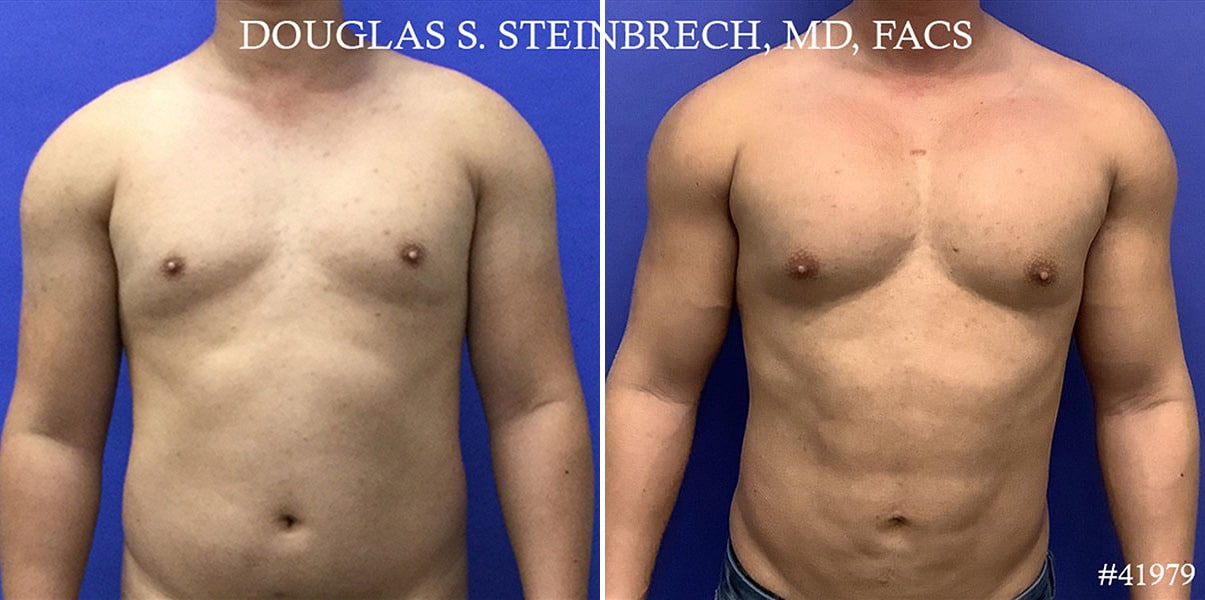
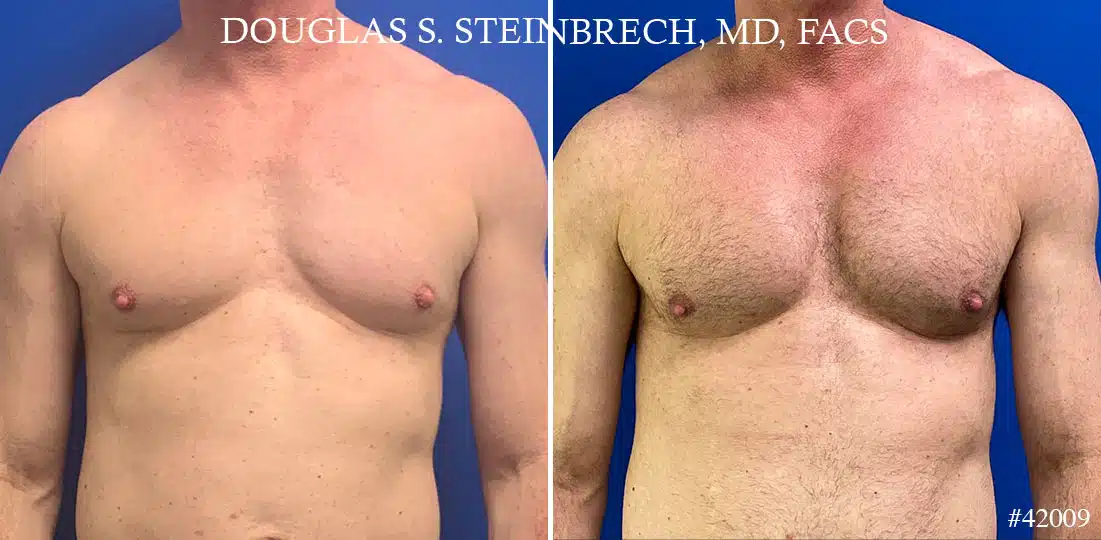
Pectoral Implants: Building the Structure That Training Can’t
Where gynecomastia surgery removes, pectoral implants add. This chest implant procedure is designed for men who want more definition, projection, or symmetry in the pectoral region — but whose anatomy simply won’t allow them to achieve it through exercise alone.
Pectoral implants are solid silicone implants custom-selected to complement each patient’s existing frame and aesthetic goals. They are placed beneath the pectoral muscles through a small incision concealed within the armpit, leaving no visible scarring on the chest itself. The implant procedure is performed on an outpatient basis under general anesthesia. Because the implants sit under the muscle, the result integrates naturally with the body’s existing anatomy, creating a chest that looks built rather than augmented.
The ideal candidate for pec augmentation is a man who maintains a reasonably active lifestyle, has realistic expectations about the outcome, and wants enhanced pectoral definition that’s proportionate to the rest of his body. Results are long-lasting — pectoral implants are solid silicone, and most patients never require a second surgery. Men considering this procedure are encouraged to browse the photo gallery of before-and-after results to better understand what outcomes are achievable.
Pec Implants vs. Gynecomastia Surgery: Matching the Procedure to the Problem
The core difference between these two procedures comes down to purpose. Gynecomastia reduction corrects a medical-aesthetic issue — the presence of tissue that shouldn’t be there. Pectoral augmentation addresses a structural goal — building a chest that genetics or circumstance didn’t fully develop.
In terms of ideal candidates, the contrast is equally clear. Gynecomastia surgery is suited to men with visible chest fullness, tenderness, or puffiness that hasn’t responded to changes in diet, exercise, or lifestyle. The concern is often less about size and more about texture and shape — the chest looks soft or rounded rather than firm and defined.
Pectoral augmentation, on the other hand, serves men who are lean and fit but simply lack chest mass or proportion. Their pectoral muscles may be functional, but they don’t provide the visual impact these patients are looking for.
Surgically, both procedures involve incisions and recovery periods, but the techniques differ significantly. Gynecomastia surgery works from the outside in — removing tissue to reveal the structure underneath. Pec augmentation works from the inside out — placing an implant beneath the pectoral muscle to add dimension and contour.
When Both Procedures Make Sense
For some men, the chest concerns don’t fall neatly into one category. It’s possible to have both excess tissue from gynecomastia and underdeveloped pectoral muscles — a combination that leaves the chest looking neither defined nor masculine, regardless of how much time is spent training. In these cases, gynecomastia reduction and pectoral augmentation can be performed together, removing the unwanted tissue while simultaneously building the structure needed for a stronger result.
Combining both procedures requires careful surgical planning and a thorough understanding of male chest anatomy. Dr. Steinbrech evaluates each patient individually to determine whether a combined approach is appropriate and how the two procedures interact in terms of incision placement, healing, and final contour.
Why Surgeon Expertise Defines the Outcome
Male chest anatomy is not simply a scaled version of female anatomy — it has its own proportions, muscle architecture, and aesthetic standards. Plastic surgery for male body contouring requires a specialized approach that preserves masculine structure while delivering refined, natural-looking results. A plastic surgeon without deep experience in male aesthetics may technically complete a procedure correctly while still missing the visual outcome the patient was after.
Dr. Douglas Steinbrech is a board-certified plastic surgeon based in Manhattan who has dedicated his practice exclusively to male plastic surgery and body sculpting. His work in male chest contouring spans both gynecomastia reduction and pectoral augmentation, as well as combined approaches for patients whose anatomy calls for more than one procedure. Patient reviews consistently reflect the kind of outcome men are looking for — a chest that looks like the result of discipline, not surgery. Dr. Steinbrech’s medical building is located at 655 Park Avenue in New York, NY, and consultations are available for patients throughout the Manhattan area and beyond.


SPECIALIST CARE YOU CAN TRUST
Dr. Steinbrech is supported by a brilliant team of caring staff members. You can trust the entire staff to help make your visit as comfortable and safe as possible! Learn more about Dr. Steinbrech and our Staff.
Schedule a Consultation for Male Chest Contouring in New York City
If you’ve been living with a chest that doesn’t reflect the effort you’ve put in — or one that makes you self-conscious despite your fitness level — a consultation is the most important step you can take. Whether the issue is gynecomastia, underdeveloped pectoral muscles, or a combination of both, Dr. Steinbrech will evaluate your anatomy and give you a clear picture of what’s possible.
A virtual consult is available for patients who prefer to begin the conversation remotely. To schedule, visit our contact page or call the New York office directly.